Lendlease REIT, Centurion, Wilmar, UI Boustead REIT, and Netflix
Latest News
From strategic real estate power moves in Paya Lebar to a dramatic retreat in the streaming wars, this week’s market landscape is shifting rapidly.
We dive into a billion-dollar REIT debut, dissect how valuation swings impacted a major accommodation provider, and analyze Wilmar’s resilient earnings despite a cautious dividend.
Welcome to this week’s brief on the latest corporate shifts and investment opportunities.
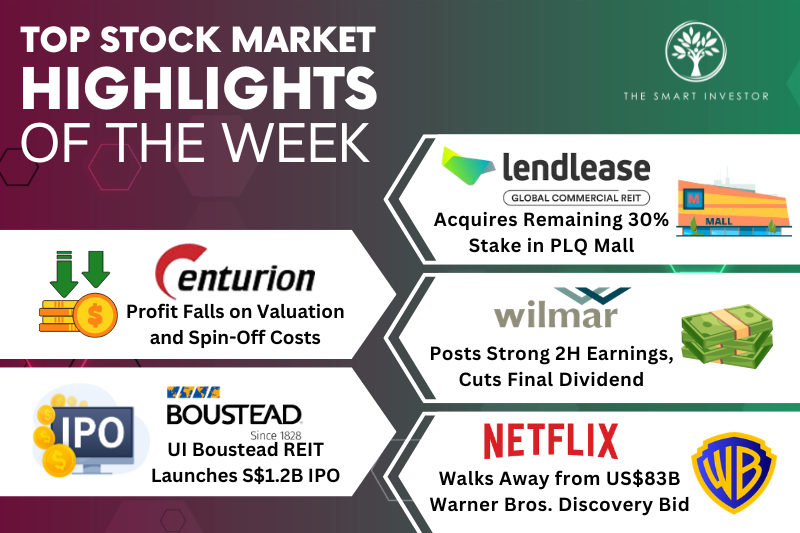
Lendlease Global Commercial REIT (SGX: JYEU), or LREIT is consolidating its hold on Paya Lebar Quarter (PLQ) Mall by acquiring the remaining 30% stake for S$116.4 million.
This move follows its 2025 purchase of a 70% interest, effectively valuing the retail asset at S$885 million.
By securing 100% ownership, LREIT gains full operational autonomy over a premier suburban hub boasting 99.4% occupancy.
The deal is a textbook example of capital optimization, projected to be 2.1% DPU-accretive through interest savings of approximately S$2 million annually.
Funding will be facilitated via a S$196.6 million non-renounceable preferential offering.
This acquisition not only solidifies LREIT’s presence in a key eastern commercial node but also pivots its portfolio heavily toward Singapore, with domestic assets now comprising 90% of total holdings.
Full control allows for more agile asset management as the precinct continues its post-rejuvenation growth.
Centurion Corporation (SGX: OU8) reported a 67% year-on-year (YoY) decline in FY2025 net profit to S$114.8 million.
This headline drop was primarily driven by non-cash accounting adjustments; specifically, fair-value gains on investment properties fell to S$22.9 million from the previous year’s S$219.1 million surge.
Additionally, S$50.8 million in one-off costs related to the Centurion Accommodation REIT (CAREIT) spin-off weighed on results.
Despite the bottom-line volatility, core operations remain exceptionally robust.
Revenue grew 17% to S$295.9 million, supported by 99% occupancy in Singapore and 98% in the UK.
Reflecting this operational strength, the board increased the total yearly dividend to 4 cents.
With the successful CAREIT listing, Centurion has established a permanent vehicle for asset recycling.
This “asset-light” strategy allows the group to unlock capital while maintaining management fees, positioning it for more sustainable, scalable growth throughout 2026.
Agribusiness giant Wilmar International (SGX: F34) posted a strong 38.3% surge in 2H2025 net profit to US$815.9 million.
Performance was bolstered by the Feed and Industrial Products segment, which saw improved crushing margins and sugar merchandising gains.
For the full year, net profit reached US$1.41 billion, a 20.6% increase despite global supply chain headwinds.
The results were further aided by a US$1.14 billion gain from re-measuring its stake in AWL Agri Business.
However, management struck a cautious tone for 2026, proposing a reduced final dividend of S$0.10.
CEO Kuok Khoon Hong cited macroeconomic uncertainties and potential trade tensions as key risks.
While higher palm oil prices supported the plantation sector, compressed margins in tropical oils and ongoing legal provisions in China created friction.
Wilmar’s future growth increasingly hinges on its pivot toward high-margin consumer products and condiments to mitigate the cyclical nature of commodity trading.
The Singapore Exchange (SGX: S68) is set for a major industrial debut with the UI Boustead REIT (SGX: UIBU) IPO, aiming to raise S$1.2 billion at S$0.88 per unit.
The initial portfolio consists of 23 diversified assets across Singapore and Japan, including high-spec industrial spaces like the Razer Southeast Asia Headquarters.
Backed by United Industrial Corporation and Boustead Projects (SGX: AVM), the trust enters the market with a strong cornerstone lineup including Amundi and JP Morgan.
Investors are drawn to the projected 7.8% annualized distribution yield for FY2026/27.
The REIT’s growth strategy relies on a massive 19.6 million square foot acquisition pipeline from its sponsors and built-in rental escalations.
With a healthy 89.4% occupancy rate and a 5.8-year weighted average lease expiry, the listing represents a significant bet on the resilience of modern logistics and business park demand in a tightening interest rate environment.
Netflix (NASDAQ: NFLX) has officially abandoned its US$83 billion pursuit of Warner Bros.
Discovery (NASDAQ: WBD) after the latter’s board favored a rival proposal from Paramount Skydance Corp (NASDAQ: PSKY).
Netflix leadership chose financial discipline over a bidding war, refusing to match a price tag they deemed “irrational” for their shareholders.
This decision caused Netflix shares to rally as investors cheered the company’s focus on balance sheet health.
The withdrawal reshapes the streaming landscape, clearing the path for a merger between Paramount (NASDAQ: PARA) and WBD.
This potential “mega-conglomerate” would unite vast libraries from HBO, CNN, and CBS, creating a formidable rival in terms of scale.
Netflix will now double down on its US$20 billion organic content budget and internal production engine.
While it loses the chance to acquire the HBO “crown jewels,” Netflix remains the sector’s profit leader, betting that its data-driven content strategy can defeat consolidated traditional media rivals.
The world’s gotten unpredictable, but some Singapore companies have quietly kept thriving. You’ve probably seen them in your daily life. And yes, they’ve kept paying dividends through it all. Meet 5 resilient stocks built to navigate global storms. Get the free report here and see how they’ve done it.
This website is created only for educational and informational purposes. Here, we discuss market psychology, price action, and smart trading concepts — to help traders improve their understanding of the market.
⚠️Disclaimer: All content on this website is for educational purposes only. We do not provide any financial advice, investment recommendations, or guaranteed profit strategies. Trading involves risk — please do your own research before making any decisions.













No comments
Be the first to comment.